Martin Pavey (OW 1959)
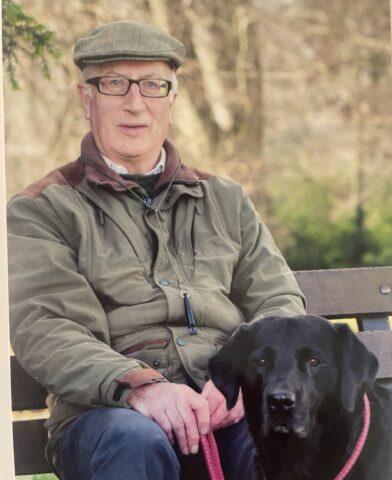
2 December 1940 – 12 March 2026
The Waynflete Office has been informed of the death of Martin Pavey, aged 85. We are grateful to his son Rob for sharing these words:
Martin’s father (my grandfather) was born in around 1894. He was a professional soldier and was commissioned into the Wiltshire Regiment shortly before the outbreak of the First World War. He fought at Gallipoli and won an MC for his actions there, before being posted to Arabia, and after the war to Oman. He married relatively late, and had three children, of whom Martin was the oldest. His wife died when the children were still young; this, and the lingering effect of wartime experiences had a major impact on the family and meant that my father had to leave MCS early, before he could do his A Levels.
He lived with an aunt for a time in Croydon, before getting a job with a shipping line in Dar-es-Salaam, as Tanganyika became independent. By the time Tanganyika merged with Zanzibar to become Tanzania in 1964, he was back in England and was working as an assistant master (in today’s world, probably a gap assistant) at Marlborough and then King’s Ely. The sequencing and dates are now hazy, but between these two jobs, he did his A Levels and got a place to read English Literature at UCL; the second of these schools was where he did his teacher training, and met my mother, who was living in Cambridge at the time.
After getting married, my mother and father moved to Sussex, where he had a job teaching English at Lancing, and my mother taught Classics at a school which has since closed. In the revolutionary days of student protests in the late sixties, he left the comfortable common room at Lancing with its armchair socialists and moved to Nottingham to take up a job as an English teacher in the newly opened Fairham Comprehensive on Clifton Estate, which was then considered to be the largest council estate in Europe. After a surprisingly short time, he was head of department, then deputy head, and finally (after failing to appoint twice) he was asked to apply to be headteacher at the age of around 36.
In the early 80s, we moved again, when he was appointed headmaster of Cranbrook School in Kent (much politer; perhaps less fun), and then 7 or 8 years later, we moved again to London, when he was appointed headmaster of Latymer Upper School in Hammersmith. He retired early (I think he argued with the board of governors, and couldn’t find the energy to truckle), spent a year doing VSO at a university in Qena on the Nile in Upper Egypt, before coming back to be an Ofsted inspector, which loathsome role he fulfilled with the maximum permissible humanity.
He and his wife Louise were married for 57 years. He was in many ways a private man, but a courteous one with a strong sense of duty and service. Outwardly conservative, there was an element of radicalism, layered in a sense of humour and a sharp sense of the ridiculous. They say that the sincerest form of flattery is imitation. I have inherited his hair style, his career and his sports jacket: I am wearing a fine piece of his tweed as I write this. I have also echoed his trajectory: Tanzania for a while, teaching in a school in the mountains; some years at MCS (as head of Sixth Form); a move to the State sector and finally being headteacher of a large comprehensive school. More than that, I owe him my deepest gratitude and respect for the man he was, and the lessons he taught me by his example. I hope my own sons will be able to write the same about me.
 Back to all Obituaries