Oxford University Blavatnik and Mathematical Institute professors address Lower Sixth
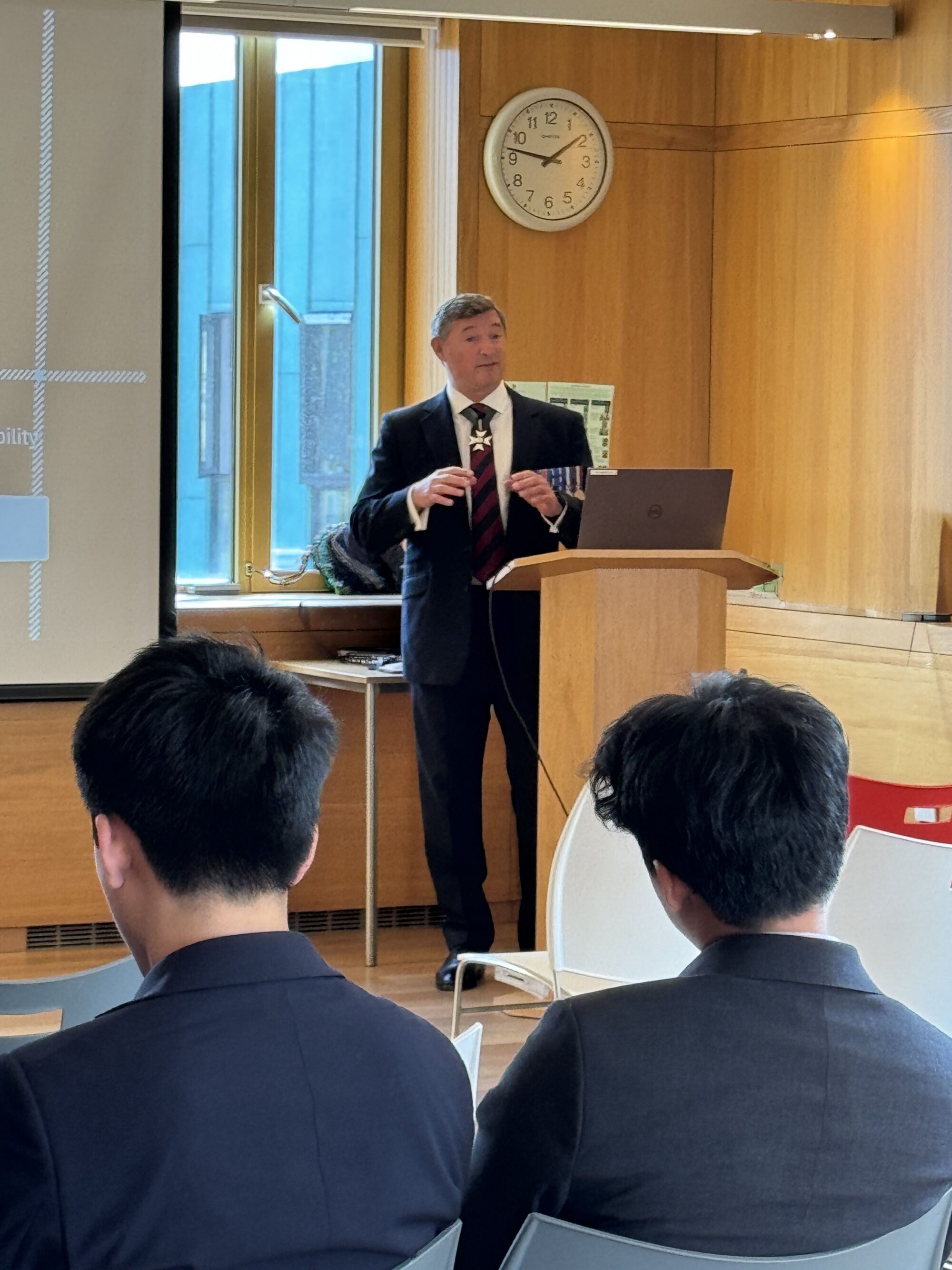
We were delighted to welcome two exceptional speakers from the University of Oxford to our Waynflete Studies programme this week: Professor Maya Tudor, Professor of Politics and Public Policy at the Blavatnik School of Government, and Raphael Hauser, Associate Professor in Numerical Mathematics at the Mathematical Institute. Representing diverse specialisms, their lectures provided an excellent opportunity for our Lower Sixth pupils to hear fresh insights and expertise as they delve deeper into their own Waynflete research projects.
During an engaging and interactive session, Professor Hauser set out to explain ‘How to throw away most of the dimensions of your data and keep what matters’. He explored how mathematicians and computer scientists can reduce the number of dimensions in large datasets while preserving the information that matters. He introduced the Johnson-Lindenstrauss Lemma, a key concept in understanding why random projections work so well. His central message was that high-dimensional geometry, although counterintuitive, allows us to “squash” vast datasets into a much smaller form while retaining the structure needed for analysis, prediction and computation.
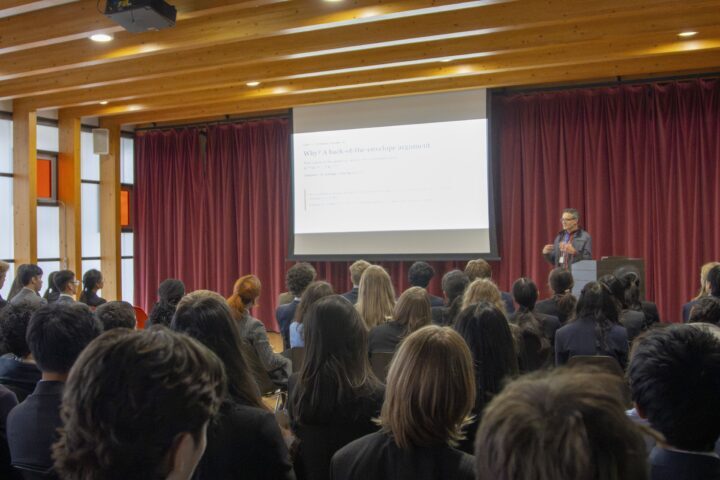
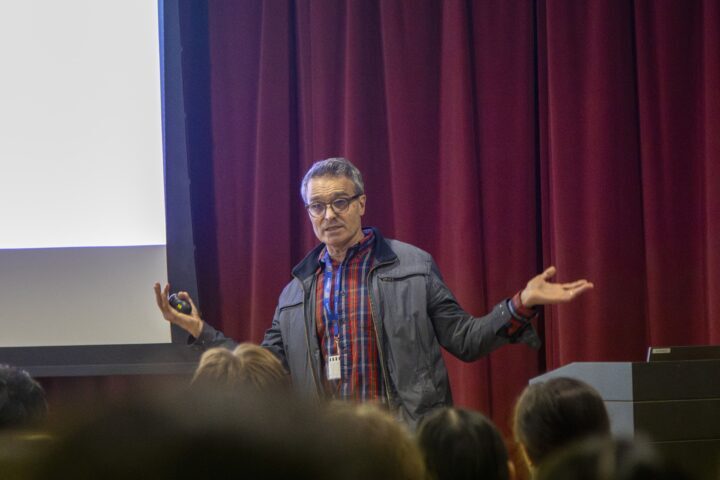
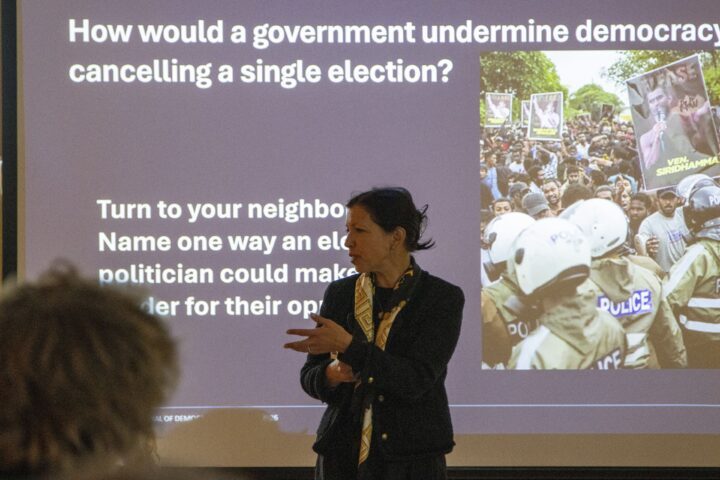
Opening with an arresting question, how would a government undermine democracy without cancelling a single election? Professor Tudor’s lecture challenged pupils to consider the role of the media in a flourishing democracy and compare the implications of recent state intervention in India, Hungary, Poland and Sri Lanka. Government pressure on the media in these countries had led to differing outcomes, with factors such as social media, journalist networks, financing and the law all playing their part. Pupils were encouraged to compare the case studies and reflect on how media-state relations can shape democratic resilience in different contexts. Throughout her talk, Professor Tudor shared valuable insights for pupils approaching their own research: to view research as a puzzle, to begin with what they most want to understand, to hypothesise rather than assume, and to remain open to surprises.
Our sincere thanks to both speakers for two thought-provoking lectures and for inspiring pupils with their knowledge, experience and insights.